



How Red Light Therapy Works: The Science Behind 633nm
Red light therapy has moved from NASA research labs and dermatology clinics into home routines — but most explanations either oversimplify it or bury it in jargon. Here is what actually happens when red light reaches your skin, in plain English.
What is red light therapy?
Red light therapy — researchers call it photobiomodulation — uses specific wavelengths of visible red and near-infrared light to stimulate natural processes in skin cells. Unlike UV light, it does not tan or damage skin. Unlike lasers, it works at low intensity across a broad area, which is why it is comfortable enough to use at home.
The wavelength matters more than the brightness. Most clinical research on skin has focused on red light around 633nm — the wavelength often described as the gold standard for skin studies — and near-infrared light around 850nm, which reaches deeper tissue.
What happens inside your skin
When 633nm red light reaches your skin, it is absorbed by structures inside your cells — most notably the mitochondria, the parts of the cell that produce energy. Research suggests this absorption can support the cell's energy production, which in turn supports the processes skin cells are already responsible for: producing collagen, repairing daily damage and maintaining firmness and elasticity.
Think of it less as forcing skin to do something new, and more as supporting the machinery it already runs.
What the research says
Red light was first explored by NASA for supporting tissue repair, and it has since been studied for skin applications for decades. Published studies have looked at fine lines, skin texture, firmness and post-treatment recovery. Results across studies suggest consistent use over several weeks is where visible changes tend to appear — this is not a one-session effect.
For a realistic week-by-week picture, read our 30-day results timeline.
Why consistency beats intensity
Skin renews itself on a cycle of roughly four weeks. Because red light works with your skin's own biology rather than resurfacing it, the visible payoff follows that cycle. Ten minutes a day, most days of the week, is the pattern used in much of the research — short, regular sessions rather than occasional long ones.
One mask, four wavelengths
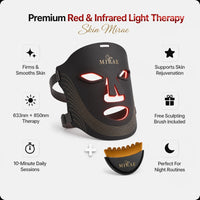
The SkinMirae Advanced LED Mask combines 633nm red light with blue light (studied for breakouts — see our guide to blue light for blemishes), 850nm near-infrared for deeper support, and a combined purple mode. Each mode targets a different concern, so one device can cover firmness, breakouts, renewal and overall glow.
Frequently asked questions
Does red light therapy hurt?
No. Sessions are painless and produce little to no heat. Most people use the time to unwind.
Is it safe for all skin tones?
Red light therapy does not rely on pigment absorption the way some laser treatments do, and it is generally considered suitable across skin tones. If you have a medical skin condition or take photosensitising medication, check with your doctor first.
How long until I see something?
Most research protocols run 4 to 12 weeks. Many users notice early changes — often in skin tone and texture — within 3 to 4 weeks of consistent use.
Ready to build the habit? Explore the SkinMirae LED mask — 10 minutes a day, from your own sofa.